Guest Blog on precision welding in collision repair: Choosing the right process for the job

Effectively combine MIG/MAG welding with resistance spot welding in structural repairs, utilizing advanced equipment to ensure repeatability, control, and adherence to OEM procedures.

Key Highlights

  • Effective repair involves seamless process transition, with MIG/MAG handling continuous joints and spot welding restoring factory connections for structural integrity.
  • Different sections of high-strength steel require specific welding methods, such as controlled MIG welds and OEM-equivalent spot welds.
  • Proper setup and parameter control are crucial for consistent, high-quality welds, especially when working with varying materials and coatings.
  • Car‑O‑Liner CMI series and CTR 9 equipment provide repeatable settings and real-time monitoring to ensure weld accuracy and compliance with OEM procedures.
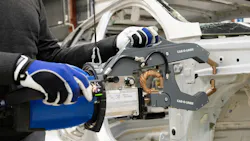
Walk through a repair on high-strength steel, and you’ll see it immediately — there’s no single welding method that carries the job. One section calls for a controlled MIG weld, and another needs OEM-equivalent spot welds. The margin for deviation is tight, and the consequences show up quickly when something’s off. The challenge isn’t learning the processes. It’s knowing where each belongs and running them the same way every time.

MIG/MAG still handles a large share of structural and panel work. The fundamentals are familiar: wire feed, shielding gas, stable arc. Material thickness, coating, and heat input still vary. Small adjustments in travel speed or gas mix can affect fit, distortion, or coating integrity. That’s why setup carries more weight than the weld itself.

Match wire and gas to the material. Set parameters with intent, then leave them alone. The Car‑O‑Liner CMI series is built around that principle: repeatable settings, controlled arc behavior, and alignment with OEM repair procedures.

On a CMI 300 Pulse, double pulse provides tighter heat control on aluminum while maintaining a consistent weld profile. The arc stays stable, which means less spatter and fewer corrections mid-pass.

Where MIG/MAG fits in a multi-process repair

Even when MIG/MAG is dialed in, it doesn’t handle everything. You’ll reach a point where the procedure shifts, usually at a factory joint. High‑strength steels rely on spot welds to maintain predictable load paths. Replace those with a continuous weld, and you’re changing how that section behaves under stress.

MIG/MAG covers sectioning, continuous joins, and material transitions. But when the OEM specifies resistance spot welding, the goal is to rebuild the joint as designed.

Replicating OEM spot welds with controlled output

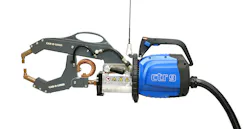
The Car‑O‑Liner CTR 9 is built for that level of control. A 16,000A transformer, integrated sensors, and CAN bus communication manage the weld cycle from start to finish. Current, time, and clamping force are monitored in real time, with deviations flagged immediately. In automatic mode, consistency tightens across technicians. That’s difficult to maintain manually.

The AW-Tong extends that control into OEM‑approved workflows. Approved by BMW as an optional accessory for CTR9, the AW-Tong supports repairs where documentation and parameter accuracy aren’t flexible.

On the floor, it changes how decisions get made:

  • Measures panel conditions before the weld cycle
  • Calculates current, time, and clamping force automatically
  • Sets parameters to produce a consistent weld nugget

No estimation. No rework when stack thickness changes.

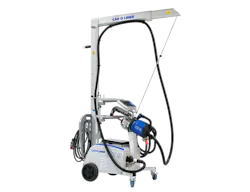
The hardware supports that consistency in practical ways. A 355° swivel handle and ergonomic grip maintain steady positioning, even in tight areas. The telescopic support arm is adjustable, so you’re not forcing angles to complete a weld. A lightweight transformer gun reduces fatigue, and a 20 ft. cable gives you range without constant repositioning.

Where the processes meet

MIG/MAG and resistance spot welding are often treated as separate capabilities, but they overlap onoverlap nearly every structural repair: one handles continuous joints, while the other restores factory connections. The handoff between them is where time is either gained or lost.

Set MIG/MAG with intent. Transition to spot welding when the procedure calls for it. Let systems like CTR9 and the BMW-approved AW-Tong handle control and documentation where precision matters most. Because the expectation isn’t just a weld that holds. It’s the correct weld, in the correct location, repeated without variation from start to finish.

Learn more: Welding processes that follow OEM repair procedures

Related Reading: Meeting the challenges of evolving materials with advanced technology welders

About the Author

Lara Jones

Lara Jones

Lara Jones is a content writer for Snap-on Equipment.

Sign up for our eNewsletters
Get the latest news and updates