Chess: Teaching aluminum panel repair 'tricks' to 'old dogs'
Key Highlights
- Training can help technicians understand aluminum's properties and improve repair skills, including heat application and tool use.
- Proper cleaning, use of the right tools, and adherence to OEM procedures are critical for successful aluminum dent repairs.
- Glue pulling is becoming the primary method for panel damage repair due to its advantages like reduced heat, minimal coating damage, and suitability for both steel and aluminum.
- Investing in quality tools, guaranteed systems, and proper training is essential for technicians to perform effective and durable aluminum panel repairs.

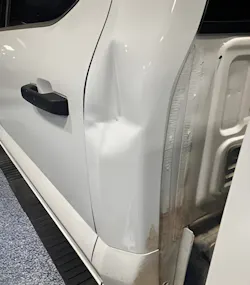
This is a cab corner on an aluminum-bodied F-250. There is no access to the backside. Would you estimate to replace or repair? The overwhelming answer that I get from shop owners and estimators is REPLACE. The main two reasons for the “replace” option are tools and training. Let’s start with training.
The easiest place to get started with aluminum dent repair training is through I-CAR. You start with an online class. It is designed for the student to understand the various aspects of aluminum, such as alloying, work hardening, and characteristics. It also discusses tools, use of heat, contamination, and annealing, just to name a few. This article is not about the theory (I could not help myself; there is some theory), but what to expect from the I-CAR Aluminum Panel Repair and Replacement hands-on skills development program. You are probably wondering what the title has to do with aluminum panel repair. I will explain.
I received an assignment from I-CAR last December to conduct the hands-on program at Marina Auto Body (Editor’s note; now owned by Chilton Auto Body) in Huntington Beach, California. I had two technicians signed up for the class, Jack Cook and Tuyen Nguyen. If you were to walk in on us, you would have thought you were at an AARP convention. Both Jack and Tu are over 60, I am over 80, and only gray hair was visible. I have known Jack for over 20 years. He’s a superior mentor and a master technician, but he has limited knowledge on aluminum panel repair. I have known Tu over 10 years, and he has no experience in aluminum panel repair. I put a dent the size of a silver dollar on the upper portion of the panel with a very large ball peen hammer.
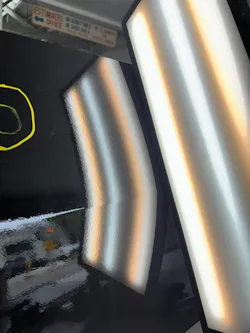
This photo was taken at another event showing the actual size of the dent. The smaller circle was the size of dent without the aid of the light, but the size increased with the light (the large circle). I started off the skill test with the use of heat.
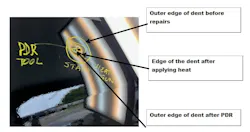
Three characteristics of aluminum are its high thermal conductivity, no memory, and annealing. In layman’s terms, high thermal conductivity means it will get very hot in a short amount of time and stay hot longer, too (always wear hand protection when using heat on aluminum). Aluminum has no memory, which means it will not go back to its original shape when repairing. In other words, you will physically have to bring it back to its original shape. Lastly, annealing is a permanent softening of the aluminum after it reaches a certain temperature (around 600 degrees F). Always check OEM procedures for the temperature and duration of heat allowed.
I previously stated that aluminum has no memory, but applying heat relieves some of the pressure on the edges of the dent, allowing the metal to return to its original shape. Note that the outer edge of the dent has shrunk. The next skill that Jack and Tu had to learn was the use of a PDR push tool.
On this part of the skill test, Jack moves the high spot (the low spot on the front side of the panel) to the low spot, pushing the dent in all directions. Look at the previous photo and notice how much of the perimeter has been reduced.
The next skill test uses a hammer and dolly. I have some examples of the tools used in the aluminum panel repair process.
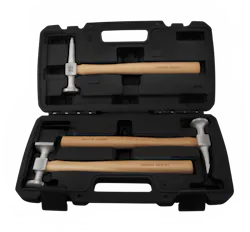
These hammers are constructed from aluminum and have three different types of head opposite the traditional round head.
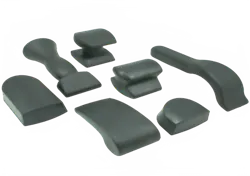
The steel core in each dolly has a dense rubber covering that absorbs the harsh impacts. With soft edges and rubber coating, there is less damage to the aluminum.
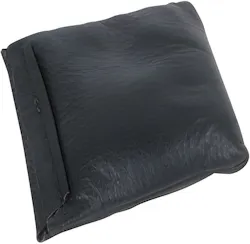
This is a dead blow, leather/lead shot dolly that will not damage the metal surface.
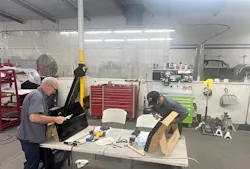
Jack and Tu were shown how to use the hammer and dolly to move the crown of the dent to the valley using light strokes. One item that was stressed was overhammering, which causes the metal to work harden and possibly crack. The next skill was how to properly use the aluminum weld-on studs.
Just some of the highlight pictures (from other I-CAR events).
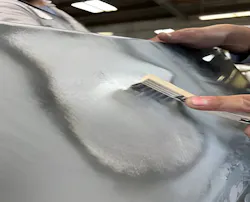
It is extremely important to clean the bare aluminum with a stainless steel brush (to prevent galvanic corrosion) and 99 percent alcohol (check with the OEM for what they state for cleaning) to remove all aluminum oxide. Series 6 aluminum is alloyed with silicon and magnesium. Some companies combine the two majoring elements into a single pin and in the picture below, this company has one pin with magnesium and the other with silicon.
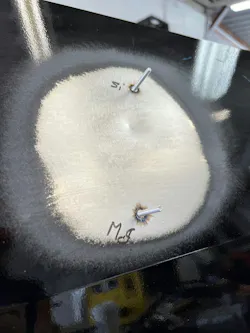
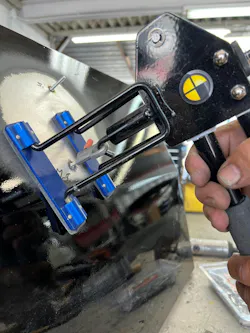
Both pins were attached (at 90 degrees to the panel) to a cleaned area of the panel, and the one that held better was then used to pull the dent.
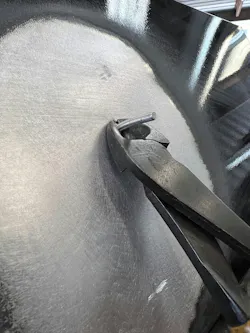
The pin was removed with a side cutter. Most technicians I have taught wanted to use a grinder with a 50 grit or coarser to remove the pin which will ruin the surface. An 80-grit DA works the best (no more than 80 grit sandpaper should be used on bare aluminum). The glue tabs were next, but I used the system when the complex dent was repaired (this part of hands-on training is scored for pass or fail).
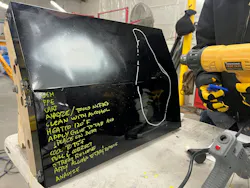
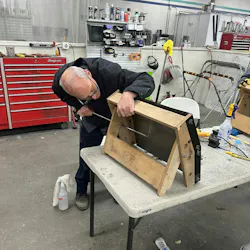
A block of wood and a sledgehammer was used on the body feature line to create damage on the aluminum panel. The depth was measured on the body feature line and the upper and lower sections. Next, the dent was cleaned with the alcohol, and a PDR light was used to outline the damage. At this point, we discussed the glue tab system. Both Jack and Tu had gone through the KECO theory of the system. I explained to them that it was extremely important to follow the company’s step-by-step procedures to ensure a successful glue pull (I had them photo the procedures to review when they used the system). I had them proceed to repair the complex dent with any of the tools that were available.
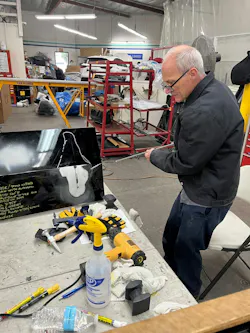
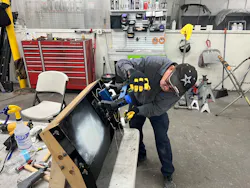
Photo showing Tu utilizing KECO Glue Tab System. I failed to mention at the start of the article that our goal for the final measures was zero or metal-finished. Jack finishes up the bottom section by moving high areas to the lower area (small back vertical lines) using a special KECO PDR hammer.
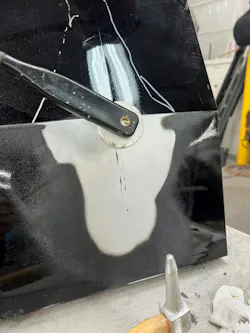
Tu’s reaction at the start of the class was to panic because he did not understand what metal-finish meant. I explained to him “No Bondo”
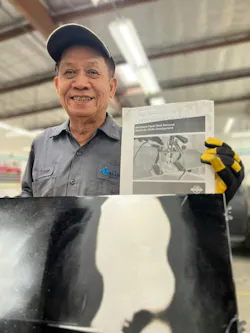
Check out the smile on Tu after successfully producing a metal finished panel. Note that I wrote on his workbook “metal finish, no Bondo.”
I would like to finish with some comments on glue-tab pulling, but look at the repaired cab corner on the F-250 from the beginning of the article.
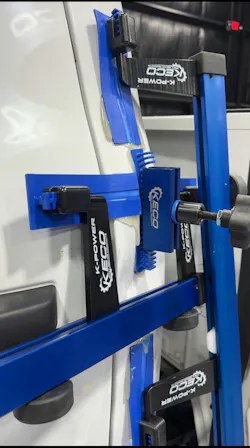
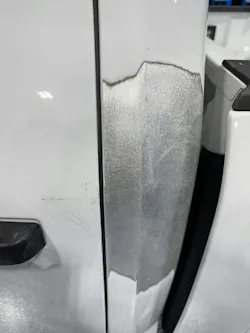
Glue dent pull repair is going to be the primary process for panel damage repair in the collision industry. The advantages are no heat, less intrusion to factory-applied coatings, it works on both steel and aluminum, and it reduces cycle time, to name just a few. Beware of cheap systems offered by online retailers like Temu and Amazon.
Things to look for before purchasing:
Are the tools and tabs fully guaranteed?
Does the company offer training?
Are the pulling devices strong enough for glue-pull dent repair?
My final comment: You can teach us old dogs new tricks, but please be patient with us, ‘cause we’re old.
About the Author
 Toby Chess
Toby Chess
A Hall of Eagles recipient, Toby Chess is known throughout the collision repair industry for his training for I-CAR and SCRS, and technical presentations at CIC meetings. He estimates he's taught more than 7,000 hands-on I-CAR welding classes, plus 15,000 other live classes in multiple states.
An advocate for body shops and their consumers, Toby has been awarded the SCRS Lifetime Achievement and Industry Achievement Awards, Collision Industry Individual Service Award, Humanitarian Award, and the ABRN Leadership award.