This Month in BackBay – by Collision ProAssist: Dodge Durango SRS issues and leveraging TSBs
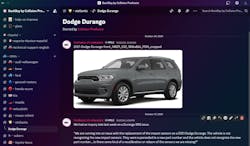
This month, I wanted to share a recent inquiry related to a Dodge Durango and a side-impact sensor. The inquiry we received read, in part: “We are running into an issue with the replacement of the impact sensors on a 2021 Dodge Durango. The vehicle is not recognizing the new impact sensors. They were superseded to a new part number, and the vehicle does not recognize the new part number….Is there some kind of a recalibration or relearn of the sensors we are missing?”
This facility had done research on the issue, was working with a local dealership, and even made a call into Stellantis. Unfortunately, none of those yielded any positive results. Eventually, they were put in touch with us, and we too did our normal research; also with no luck.
Next, we escalated the inquiry to our main contact at Stellantis. Our contact wasn’t aware of any issues and ultimately forwarded the request to their diagnostic team. A couple of days later, here’s what we found out:
“2022 and earlier Durango models (WD) came with 68492236AA (side) impact sensors. 2023 and newer models use 68606355AA. However, the newer (68606355AA) sensor is not compatible with the original ORC module and therefore, needs to have the 2023 and newer ORC module installed.” The only remedy for this issue is to replace the control module along with the impact sensors.

“The ‘new’ ORCs for the WDs are as follows:
1) ORC 68615035AA (was previously 68492238AD) 5.7 and 3.6 engines ERC EZH sales codes.
2) ORC 68615038AA (was previously 68492237AD) SRT engines 6.2 and 6.4L ESG ESD sales codes."
A technical service bulletin is being developed by Stellantis; unfortunately, it is not available at the time of writing. When the TSB is available, we’ll let BackBay members know and I’ll include a reference to it in a future article here.
Although a TSB wasn’t available for this Durango, there are plenty of examples when a relevant TSB is published. We often think of TSBs as something developed for automotive service professionals (and that’s usually accurate), but they can also prove useful for collision repair professionals. Here’s an example of another recent issue where a TSB was effective in solving a mystery.
A 2023 GMC Yukon collision deployed every airbag except the driver's bag. This vehicle matched GM TSB 23-NA-085 (NHTSA MC-10236071-0001), citing a code and scenario where the driver's seat side airbag connector rubs the seatback cushion, interrupting contact during seat adjustment or movement; this would certainly cause a non-deployment. Instead of chasing this airbag mystery for hours, days, or weeks, a quick TSB search may deliver answers fast so you can move on.
When you are faced with an issue that has you scratching your head, don’t forget to see if there are any TSBs available; you might be surprised. And, if that doesn’t work, you can turn to BackBay and we’ll reach out to the OEM and work on getting you an answer. I hope to see you in BackBay soon.
I launched Collision ProAssist and This Month in BackBay late last spring to better support collision repair technicians. The men and women who repair collision-damaged vehicles are the cornerstone of our industry, yet I’ve long felt they’re the least supported group in the industry, and I am aiming to change that. BackBay provides technicians, including Spanish-speaking technicians (and other languages), with answers to their collision repair questions, allows direct interaction and education with OEMs and tool, equipment, and product makers, and offers other resources for outside of the shop, including financial resources and physical and mental health support. If you want to learn more, email me at [email protected] or click here.
-- Jason Bartanen
About the Author
 Jason Bartanen
Jason Bartanen
Founder and Chief Technician Advocate
Jason Bartanen is the founder and chief technician advocate of Collision ProAssist, where he guides technicians through technical support and tailored education. He has been in the collision repair industry for nearly 30 years, including more than 23 years serving in various roles for I-CAR, the Inter-Industry Conference on Auto Collision Repair. He was most recently the director of industry relations at Collision Hub for nearly six years.